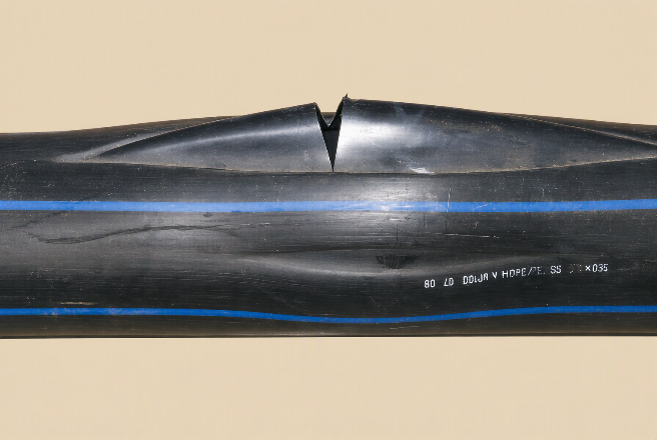
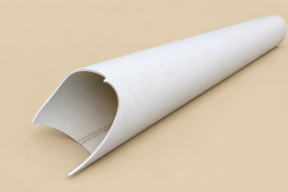
Products, made from any material like metals or polymers, basically show two types of failure under load: ductile and brittle. In the photographs below both types of failure are shown for a polymer pipe. Whether a product like a pipe fails ductile or brittle is dependent on the material and the circumstances.
No construction material, whether it is a plastic or a metal, is perfect. They will all contain small defects like micro cracks, voids, inclusions and other imperfections. Such defects are also called flaws. When a material containing flaws is deformed a stress will be created that is proportional to the deformation (Hooke’s law). However, in the close neighbourhood of a flaw the stress will change. In some regions the stress reduces to zero while in the edges of the crack stresses become much higher.
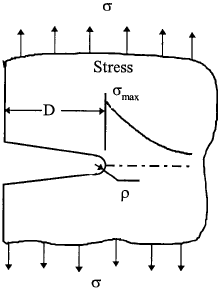
The regions of higher stress are called stress concentrations and they strongly dependant on the shape of the flaw. For example, around a spherical cavity the stress is 3 times higher than far away from the cavity. In case of a defect with sharp edges the stresses may be 10 to 100 times higher than the average stress in the remaining material.
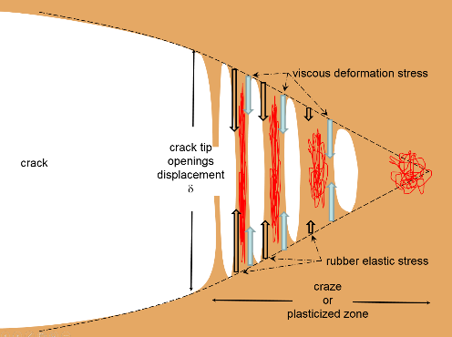
These very high stresses near the cavity tip will cause the material to yield (see Figure 78). New surface is created and the crack will grow. The speed with which the crack grows is the crack growing speed. After some time, the growing cracks will have reached a critical level. Then the crack growing speed will increase strongly which results in a sudden brittle failure of the product.
The time to brittle failure is strongly dependent on the size of the cracks, the stress applied and the temperature. Increasing stress will cause the time to brittle failure to reduce. However, due to the small size of the defects, the critical stress at which the product fails within seconds is usually much higher than the yield stress. Therefor short-time failure of the product due to high stress will normally be ductile and not brittle. The material yields.
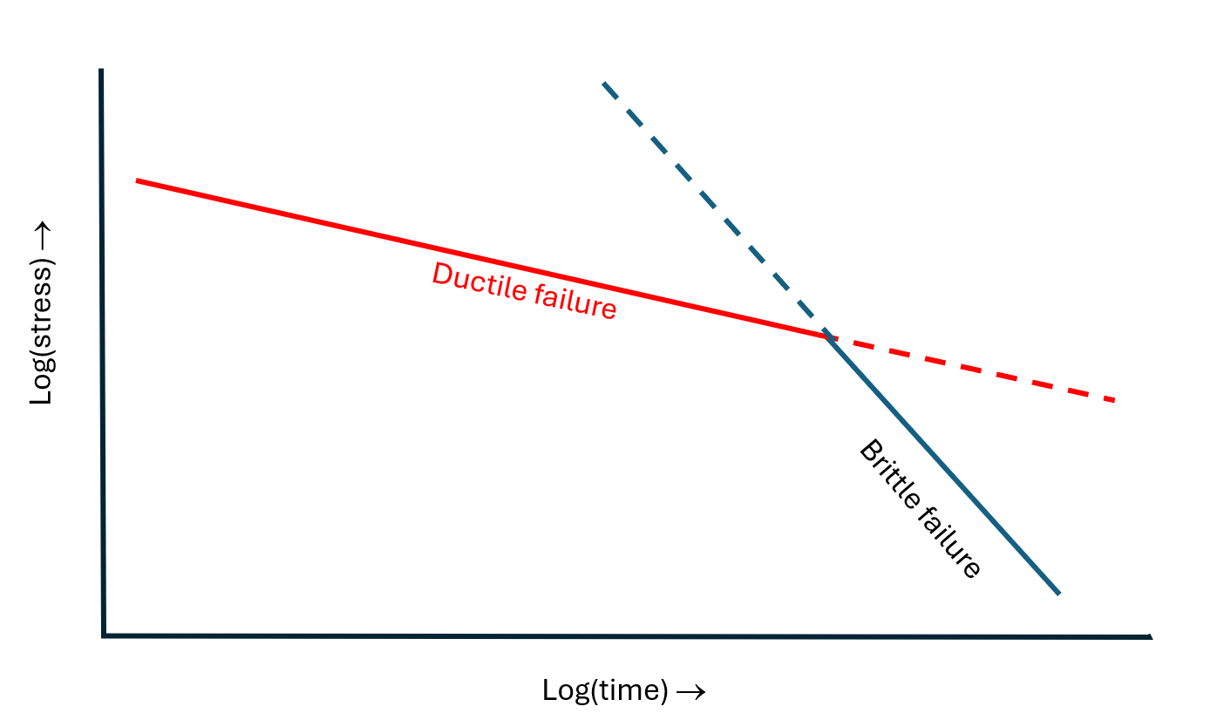
The situation is different when a product is loaded with a relatively low stress. Now the cracks will grow slowly until, after some time, they reach a critical size. Then the product suddenly fails brittle instead of ductile. This will happen far below the yield stress.
During long-term testing it is well known that higher stresses will cause the product fail ductile and reduced stresses will cause the product to fail brittle. A sketch of ductile and brittle failure versus stress and time is shown in the figure above.
Summary
- Every material will contain small defects (flaws) that influence the mechanical properties.
- Near the edges of a defect a concentration of stress will be formed when the product is loaded. In this region the stress may be 10 to 100 times larger than the average stress.
- These stress concentrations make the polymer material yield near the edges causing the crack to grow.
- When the size of the crack has reached a certain critical level the product will fail brittle.
- The time needed for growing to the critical size is the time to brittle failure.
- The time to brittle failure increases with reducing stress.
- The critical stress for short-time brittle failure is usually larger then the yield stress. Therefor high stress usually results in ductile failure.
Learn more: